
Sunrise Previous Resident Sources
A Sunrise address has several histories at once. The Broward County Property Appraiser, or BCPA, gives the current parcel key, sales clues, legal description, situs address, and tax mailing address. Broward County Records, Taxes and Treasury holds the recorded instruments that transfer or encumber the land. City building files document work on an improved lot. Library and archive sources add subscribers, news mentions, and local context. Together they form the soundest trail to previous residents, but each describes a different fact.
| Sunrise source | Time span | Custodian | Evidence found |
|---|---|---|---|
| Official Records index | Full party search after July 7, 1977; limited from March 9, 1972 | Broward RTT | Deeds, parties, dates, instruments, book/page and legal descriptions |
| Older recorded books | Before the online party-search range | Broward Search and Copy | Earlier transfers found from a citation or legal description |
| Regional phone directories | Historic volumes, including a digitized 1947-1951 run | Library of Congress and Broward Library | Listed subscriber, street address and telephone |
| Federal census | Public schedules through 1950 | Archives and licensed library databases | Households in pre-Sunrise Broward geography |
| Building records | Most files retained on microfilm | Sunrise Building Division | Permits, applicants, plans, certificates and improvements |
For a recent chain, start with BCPA and the latest deed. For an older building, preserve the folio, plat, lot, block, and book/page references before leaving the online index. Sunrise did not incorporate until 1961, and it used the name Sunrise Golf Village until 1971. Earlier material may sit under Broward County, a subdivision name, or regional Fort Lauderdale telephone service rather than under the current city name.
Start Sunrise Previous Residents by Parcel
The BCPA Property Search accepts an address, owner surname, legal subdivision, or folio. Choose the exact address match and copy the folio and legal description before following a sale link. Situs means where the parcel lies. Mailing means where the tax notice goes; it is not proof that a person lives there. Homestead and a matching situs and mailing address may support owner occupancy for a tax year, but they still do not identify every person in the home.
A parcel card can show the owner, use code, land and building values, sale date, deed type, effective age, and sketch. Those fields help distinguish the property and date an improvement. They do not replace the recorded instrument. Use the latest sale and deed clue to enter the county index, then match the legal description rather than relying on a familiar street number.
Keep the stable key. A folio and lot-block description can survive a postal label, city name, or street-address change.
Trace Sunrise Previous Owners
A chain of title is the sequence of recorded transfers for the same land. In the Broward Official Records Search, the direct party is usually the grantor, the person or entity giving an interest. The indirect party is usually the grantee, the recipient. Confirm those roles in the deed image because document types vary. The index also supplies record date, instrument number, book/page, document type, and a legal field.
- Copy the current assessed owner, folio, legal description, latest sale date, and deed clue from BCPA.
- Find that owner's acquisition deed. Check the grantee, grantor, legal description, and instrument image.
- Search the seller's name as a grantee to locate that party's earlier acquisition of the same parcel.
- Repeat the match. Include trusts, probate orders, tax deeds, foreclosure certificates, and name changes when a normal sale is absent.
- At the online coverage break, take the legal description and book/page or instrument citation to Search and Copy.
- Grantor / grantee
- The grantor gives the recorded interest; the grantee receives it.
- Chain of title
- The linked sequence of transfers for one parcel.
- Legal description
- The plat, lot, block, metes-and-bounds, or other land description that identifies the property more reliably than a street label.
Sunrise Previous Records Cutoffs
Broward's web index has an unusually exact boundary. Full party-name searching begins July 7, 1977 at 1:47 p.m. From March 9, 1972 at 11:28 a.m. through July 7, 1977 at 1:46 p.m., searching is limited to instrument number, book type and page, or record date. Earlier documents are absent from the online party index. Calling the system simply a “1978-present” search can hide the narrow but useful earlier band.
Later deeds often recite an earlier instrument or book/page. Capture that citation. Broward RTT's Search and Copy service is the fallback for older instruments and copies. The recording office is at 115 S. Andrews Avenue, Room 114, Fort Lauderdale, and is open weekdays from 8:30 a.m. to 5 p.m. Phone access is available at 954-831-4000 or 311. Search name variants and both party roles when a family name changed form.
Sunrise Previous Resident Microfilm
Deeds describe interests in land, not every period of occupancy. Sunrise Building Division files can date construction, major alterations, certificates, plans, permit applicants, and contractors for an improved lot. Most of these records remain on microfilm. They may be viewed or copied from 10 a.m. to 3 p.m., or by appointment, and advance notice is recommended. Call 954-572-2292 or 954-572-2353, or email BuildingRecords@sunrisefl.gov.
This offline layer is useful when the deed chain stays within one family or entity while the house changes. A permit applicant may be an owner, agent, or contractor, so state the role shown. Code files can add property activity, while a municipal lien response can report assessments and code liens. The city charges $100 per folio or address for that formal lien inquiry, with a stated three-to-five-business-day turnaround. It is a closing tool, not a list of previous residents.
Archives for Sunrise Previous Residents
Broward Main Library's Periodicals unit keeps older telephone directories on microfiche, complete local South Florida newspaper runs, and historic building surveys. Staff retrieves microform and handles remote obituary or article requests at periodicals@broward.org or 954-357-7444. Licensed library tools also include Digital Sanborn Maps and genealogy databases, but the research did not confirm a Sunrise-specific house-history guide or a set of local Sanborn years. Treat those as leads to ask about, not proven coverage.
The Broward County Digital Archives brings together 115 historical collections, including oral histories and government or family records. Its collection view can supply the local setting around past residents even when it does not index a house number.
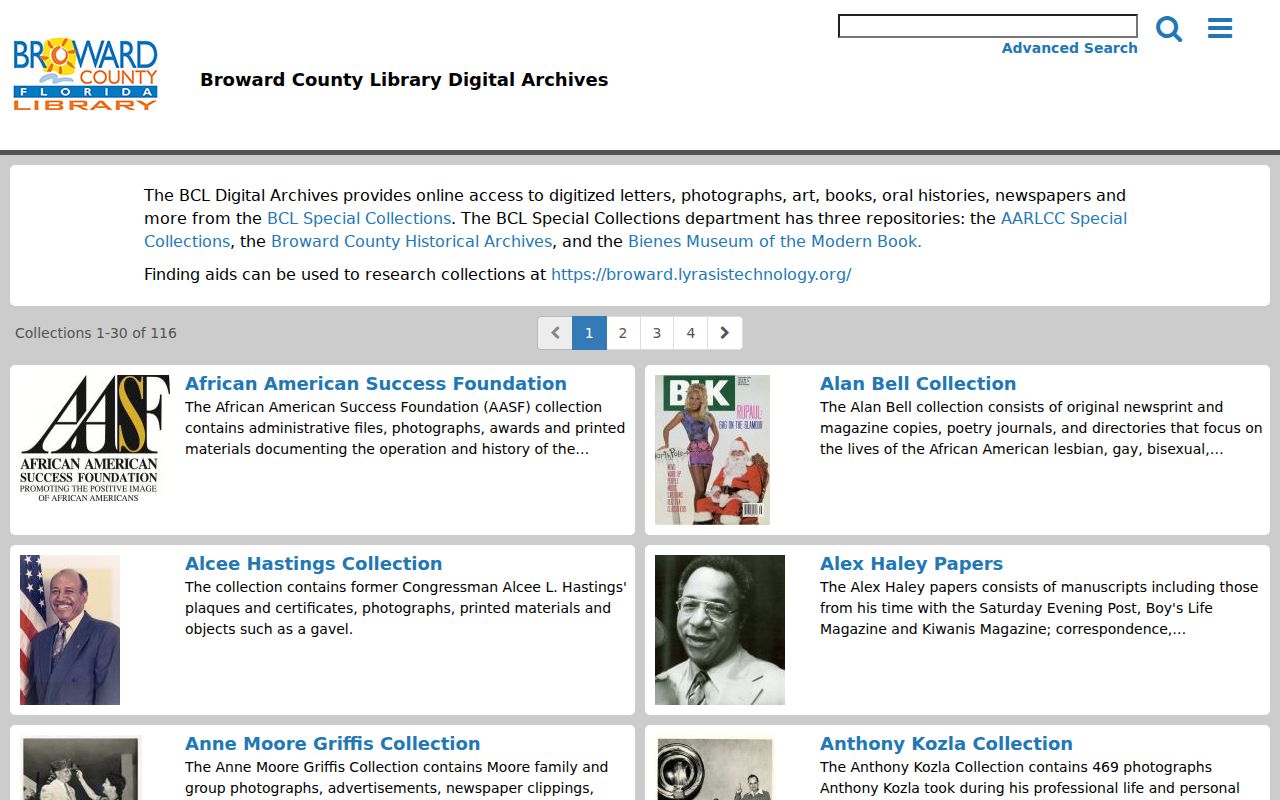
The archive screen is a route into named collections. Record the collection title, item date, and description so an image or oral history is not mistaken for direct proof of occupancy.
Match Sunrise Previous Residents
Ownership is only half of a previous residents search. A dated telephone directory names a subscriber tied to a line, not all adults, children, roomers, or renters. The digitized regional 1947-1951 Fort Lauderdale run predates Sunrise's incorporation. Search it as evidence for Broward's earlier geography, not as a roll of city residents. From 1961 through March 1971, try Sunrise Golf Village as well as regional headings. Later volumes may use Sunrise.
- Begin with a deed interval and the address form used at that time.
- Check the nearest available regional phone-directory years and note the exact subscriber, page, street, and telephone.
- For pre-development geography, locate the 1950 census enumeration district and compare household names carefully.
- Use local newspapers or an obituary to test family links, moves, deaths, and address mentions.
- Check a public probate docket when an estate or heir explains the next transfer.
An enumeration district is the small area assigned to one census taker. The latest open federal schedule is 1950, eleven years before Sunrise incorporated, so it cannot list anyone as a resident of the later municipality. A criss-cross directory is arranged by address or telephone rather than only by surname. No verified Sunrise reverse-directory run was found. Broward's phone-book microfiche is still worth checking, but label a hit as a subscriber.
The historical collection itself, including how to read abbreviations and regional headings, belongs on the Sunrise city directory page. Here, each dated entry should be placed beside the deed interval. A person's disappearance from a phone book may mean a move, death, unlisted service, or a gap in publication. It is not proof by itself.
Lawful use. Research previous residents for house history, genealogy, or an estate matter. Never use an address trail to stalk, threaten, harass, or harm a living person.
Close Sunrise Previous Resident Trails
An obituary and probate file can explain why a person leaves the address record or why title passes through an estate. Broward Clerk maintains probate cases and public court copies. Start with the docket, confirm the party role and case date, and request an otherwise public image through the Clerk when it is not visible online. A same-name result is only a lead until dates, relatives, or the property connect it.
Florida death certificates without cause of death are public. Cause of death stays confidential for 50 years. A certificate identifies an event, while an obituary may list relatives and a probate filing may document authority over an estate. Used together, they can connect a former owner or occupant to an heir without claiming more than each record proves.
The Florida Bureau of Vital Statistics explains the death-certificate request channels, and DOH-Broward offers a local route. The captured state page shows where official certificate access begins.
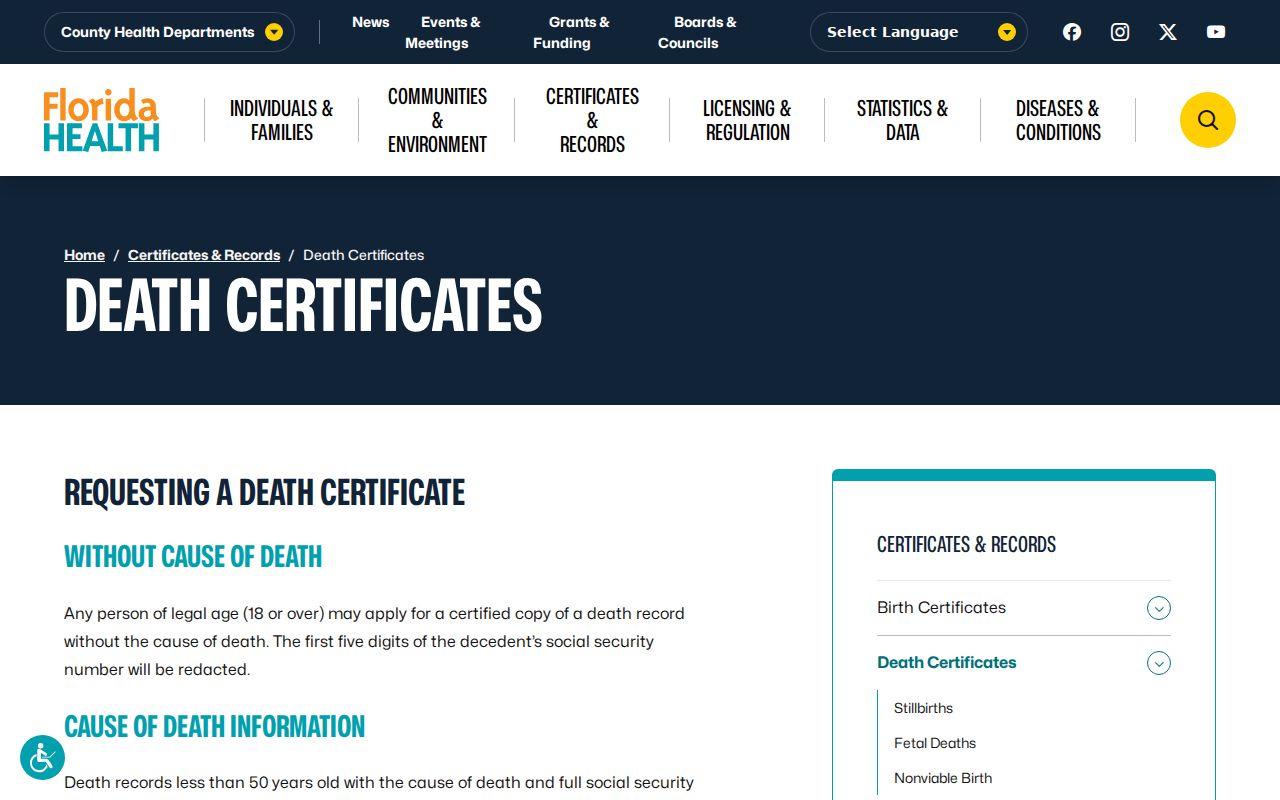
A certificate should close a specific identity question, not be used to merge similar names from an index.
When a former household ended through divorce, the Bureau also explains how to request a Florida dissolution certificate. This summary record is distinct from the Broward court file.
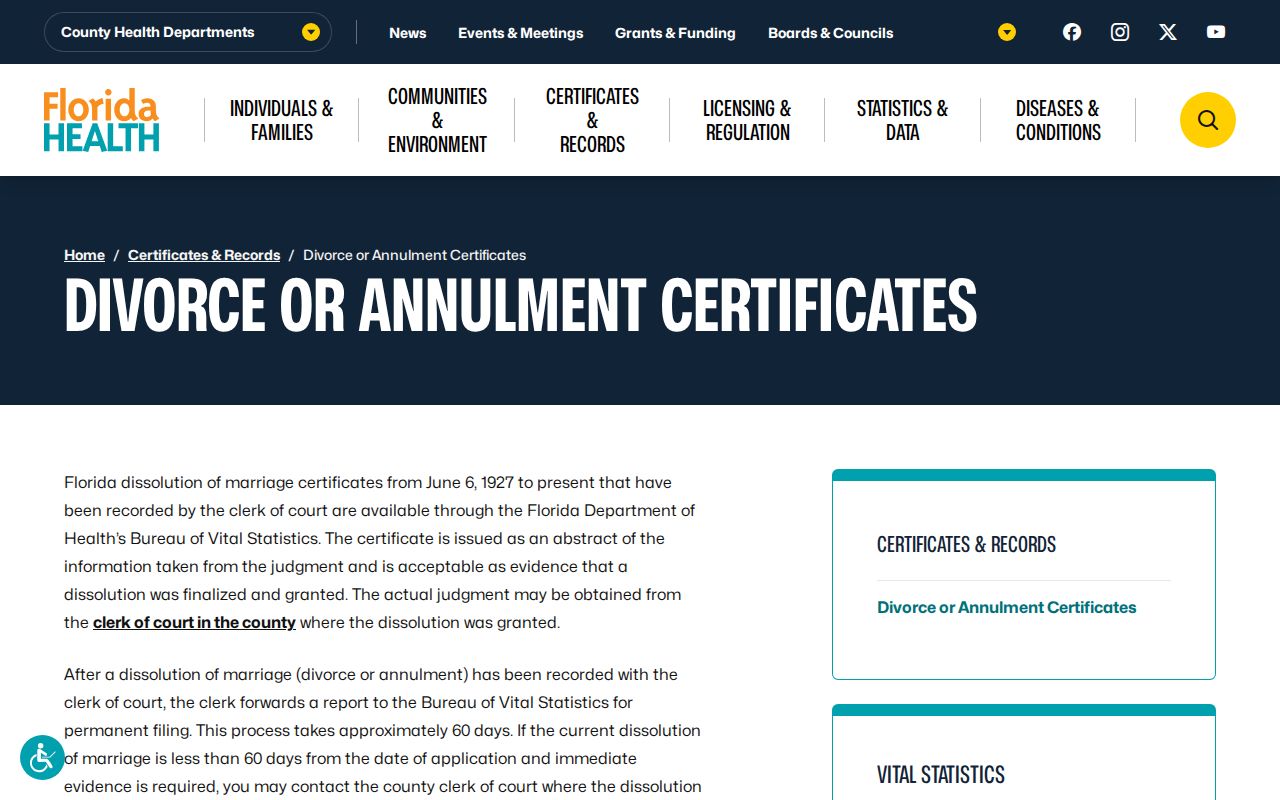
The state page identifies the certificate route; use the Broward Clerk docket when the underlying public case documents are needed.