
Verified Sunrise Directory Collections
There is no verified standalone Sunrise publisher and year run. The usable city directory shelf begins with regional telephone books and expands through Broward Library microfiche, local newspapers, county archives, and the State Library holdings search. Each source has a different coverage boundary, so label it accurately rather than turning a regional subscriber list into a complete municipal roll.
| Collection | Verified span | Repository | Access route |
|---|---|---|---|
| Fort Lauderdale regional telephone books | 1947 to 1951; linked items 1971 to 1975 | Library of Congress | Free digital gallery, PDF, and text |
| Older Broward phone directories | Exact years not published | Broward Main Library Periodicals | Microfiche retrieval or remote staff question |
| South Florida newspapers | Complete local runs; title dates vary | Broward Main Library Periodicals | Paper, microform, databases, and obituary requests |
| Broward Digital Archives | County memory from the 1890s onward | Broward Historical Archives | 115 online collections, appointment, or scan request |
| Florida city directories | Early 1900s to present statewide | State Library of Florida | Holdings search and Tallahassee research |
No official source established Sunrise-specific Polk volumes, a reverse-directory run, or exact city years on the State Library shelf. Those are real gaps. Use the proven regional volumes and ask staff to verify a year before planning a visit or citing a title.
Sunrise Directory Years Need Context
The latest federal census schedule open to the public is 1950. Sunrise did not incorporate until June 22, 1961, eleven years later. A pre-1961 entry therefore cannot be described as a resident of the incorporated city without more evidence. Search Broward County land, enumeration-district geography, subdivisions, and Fort Lauderdale regional telephone service instead.
| Era | Best label and source path |
|---|---|
| Before 1961 | Unincorporated Broward geography, deeds, plats, 1950 census, and regional phone books |
| 1961 to March 1971 | Sunrise Golf Village plus Fort Lauderdale and Broward service headings |
| After March 1971 | City of Sunrise, regional telephone headings, county records, and later annexed areas |
| Current research | Sunrise and Broward searches, with old names retained for continuity |
The city grew from about 350 residents at incorporation to more than 18 square miles. That shift makes a city name less stable than a recorded folio, subdivision, or legal description.
Population also rose quickly, reaching about 4,300 by 1967 and 15,000 by 1971. Those figures explain why the documentary trail changes shape: early development leans on acreage, plats, sales, and regional subscribers, while later neighborhoods produce more parcel, permit, newspaper, and condominium evidence.
Regional Books Before Sunrise
The Library of Congress regional telephone directory gallery verifies Fort Lauderdale-area books for 1947, 1948, 1949, 1950, and 1951. Nearby communities appear in the regional service area, and linked items reach 1971 through 1975. These are white- and yellow-page subscriber lists, not a census.
Search a surname and spelling variants, then inspect the page image and key. Optical text can misread old type, exchange letters, and suffixes. If a person appears near a place later annexed by Sunrise, state the contemporary geography. The right phrasing is “listed in a regional telephone directory at this address,” not “counted in the Sunrise city directory.”
Note: A missing subscriber may have lacked a telephone, used an unlisted number, lived with another subscriber, or fallen in a volume gap.
Sunrise Directory Research at Main Library
Broward Main Library Periodicals holds older telephone directories on microfiche and about 1,600 paper or microform titles, including complete local South Florida newspaper runs. Staff retrieves microform, teaches database use, and handles out-of-area obituary or article questions. Contact periodicals@broward.org or 954-357-7444 before traveling when the needed year has not been published online.
The local Dan Pearl Branch at 10500 W. Oakland Park Boulevard provides a nearby library channel, while deeper historical work sits at Main Library. Licensed resources include Ancestry Library Edition, Fold3, Archives Unbound, Historical Black Newspapers, regional newspapers, and Digital Sanborn Maps. Access may require a library card or an in-branch session.
Open the Broward genealogy resource list before using its databases.
The library menu points researchers toward authenticated collections that a general web search will not expose.
Read a Sunrise Directory Entry
A 1947 regional entry on the verified Library of Congress image provides the safest model. Alphabetical entries show a surname and given name, or a firm name. An occupation or business description may precede the address. The letter r means residence, followed by a street address and historical telephone number. Exchange letters, number suffixes, and a symbol for a private branch exchange require the volume's own key.
| Name or firm | The subscriber or listed business, not every person at the address |
|---|---|
| Description | An occupation or type of business may appear before the residence |
| Residence marker | r introduces the street address in the inspected book |
| Telephone | A historical exchange and number, sometimes with a suffix letter |
| Header symbol | The inspected book uses a symbol for private branch exchange service |
- Criss-cross directory
- A volume or section arranged by street address, often used to reverse an address to a listed subscriber. No Sunrise-specific run was verified.
- Householder index
- A name or address list focused on the person recorded as the household's primary listing, not all people in the home.
- Abbreviation key
- The publisher's legend for short forms and symbols. Read or save it before interpreting an entry.
A city directory entry is evidence of a listing at publication time. It does not prove ownership. It also may not identify a spouse, child, roomer, or unlisted resident.
Broward Archives Add Named Context
Broward Digital Archives brings oral histories, family papers, photographs, memories, and government material alongside sparse directory entries. The Historical Archives developed from records inventoried in the 1928 courthouse clock tower, then moved through Nance Library and West Side Grade School before reaching Main Library. That path is a local records story, not a claim of record loss.
Researchers may browse 115 digital collections, review finding aids, request scans, or arrange an appointment. Sheriff and inmate logs, court-related papers, and oral histories may supply context that a telephone listing lacks. They should still be cited as their own record types.
Search by personal name, family name, neighborhood, subdivision, and subject. A family paper or oral history can explain why a name appears under Fort Lauderdale service geography even when the later address falls in Sunrise.
Review the Historical Archives access page before requesting material.
The archive route is especially useful when a directory gives only a name, address, and telephone.
Check Florida City Directory Holdings
The State Library of Florida city directory collection spans cities and years from the early 1900s to the present. Its holdings search is the correct place to test a city, year, or regional title before contacting Tallahassee. The research did not verify an exact Sunrise publisher or run because the embedded catalog could not be fully inspected.
That limit should shape the request. Ask staff whether the catalog has Fort Lauderdale, Broward, Sunrise Golf Village, or Sunrise headings for the target year. Supply spelling variants and an address when possible. A title verified by staff is stronger than an unsourced claim that a standard publisher covered Sunrise.
See the State Library collection page for the official holdings route.
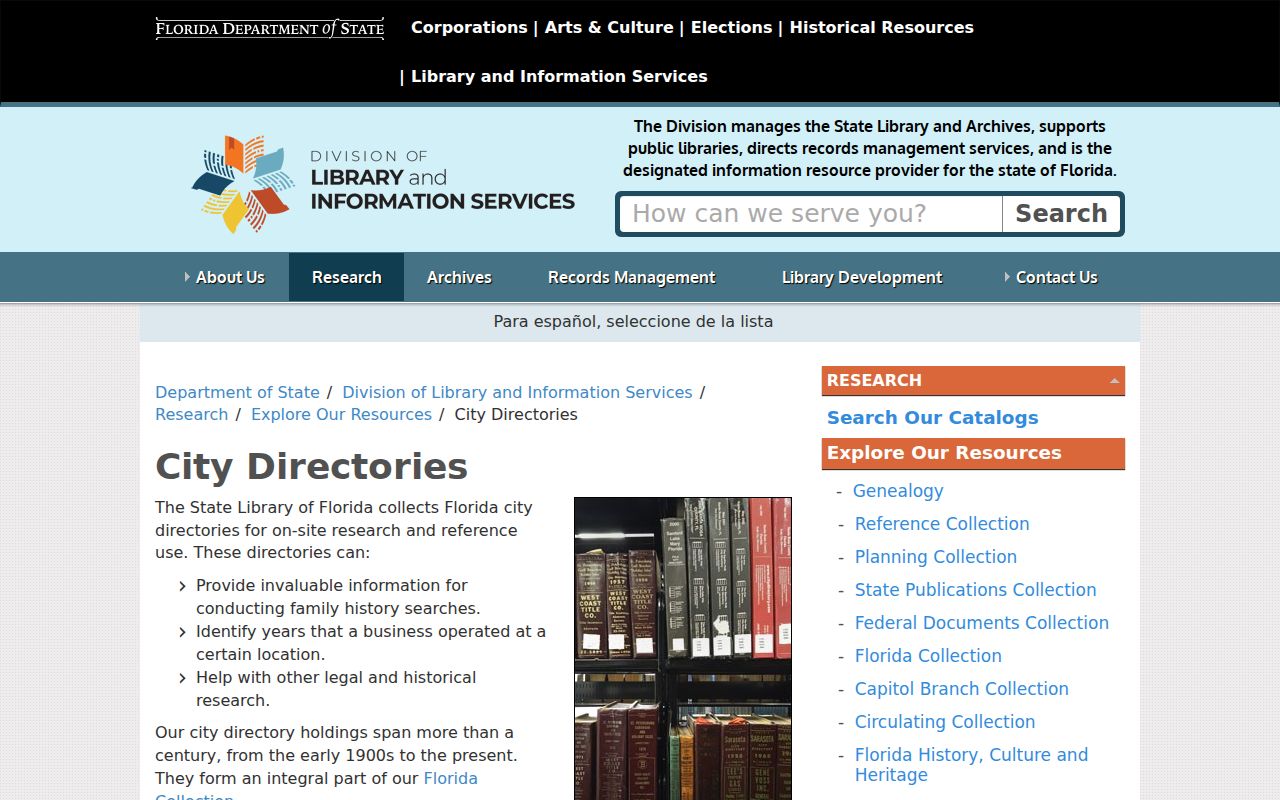
The statewide shelf expands the search without erasing the unresolved Sunrise-specific coverage gap.
Sunrise Subscribers Are Not Population
Telephone books record lines and paid listings. They omit people with no service, unlisted numbers, children, roomers, and many relatives who shared a home. Business pages mix firms and service addresses with residences. A name disappearing from one year to the next can mean a move, death, unlisted service, changed subscriber, or simply a missing volume.
Test the entry against an independent source. Broward deeds distinguish owner from subscriber. Newspapers and probate can explain a death or family tie. Census schedules help with pre-development geography, but no open census enumerates incorporated Sunrise. Avoid using a city directory count as a population count or treating silence as proof that someone left.
Trace Families Through Sunrise Directories
A city directory works best as one dated checkpoint in a longer family trail. Begin with a known person, approximate year, address, and spelling variants. Keep Sunrise's municipal chronology beside the search so that an older regional listing is not forced into a later city boundary.
- Search the nearest verified regional volume by surname, firm name, and spelling variants. Read the page image, not only extracted text.
- Move to adjacent available years. Record each address, telephone, occupation or business description, and any publication gap.
- For 1961 through early 1971, repeat the search under Sunrise Golf Village. Also test Fort Lauderdale and Broward service headings.
- Pair a listed address with BCPA and deeds. Use the 1950 census only for earlier land or nearby communities, not as a Sunrise city roll.
- Use local newspaper obituaries and probate records to test a relationship or explain a disappearance from the books.
Owners and telephone subscribers are different populations. A deed confirms a legal transfer; a directory shows a listed subscriber. When both point to the same name and address near the same date, the combined finding is stronger, yet it still does not name everyone who lived there.
Note: Preserve the volume title, year, image or page number, exact entry, and repository so another researcher can repeat the finding.